

Could Treating Reading Like Exercise Cure Brainrot?
why intellectual influencers are the new personal trainers

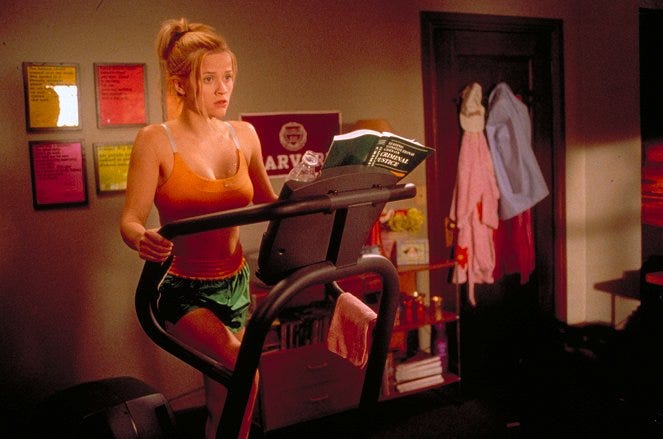
No one reads books anymore. In fact, in the UK, more than a third of adults say they have given up reading for pleasure. You don’t need me to tell you why that is. It’s because of the insane amount of time we spend on our phones, of course. But what if our rapidly increasing screen time is also the reason why we’re all about to start reading more?
This was the argument writer and The Times columnist James Marriott posed on a podcast I recently listened to. Marriott went Substack viral last year for an essay called The Dawn Of The Post Literate society, arguing that the fact we’re all reading less has severe social and political consequences (he has a book coming out on the same topic). He believes that it will impact – and, in fact, is already impacting – our cognitive capacity, ability to think critically, and be creative.
It’s scary stuff. But one point of optimism he found was that the rise of bad things often leads to the rise of good things. The example he used was junk food and exercise, both of which rose in popularity in the latter part of the 20th century. McDonalds became mainstream at the same time when people were signing up to 24-hour gyms en masse. Why? Because people knew junk food was having a negative impact on their health and they wanted, needed, to do something about it.
Marriott believes that the same thing could happen with screen time and reading, whereby our phones are the equivalent to junk food and reading that of exercise. It makes sense. 77% of Gen-Z say they spend too much time on their phones In fact, there’s so many products, apps and schemes designed to help you stay off your phone now, that it’s quickly becoming its own market sector.
People are worried about their worsening attention spans, about brainrot and the decline of original thinking. Books are the obvious solution to this. The only issue with this thesis is that, historically, the primary motivator for working out has been changing your appearance. Even now, in the age of wellness, when people are more dedicated than ever to health optimisation, working out and eating well always has the added bonus of helping you conform to societal beauty standards. Reading does not possess that shiny selling point.
However, in certain online spaces, reading is becoming a status symbol. Over the past few months, a new genre of influencer has emerged: the intellectual influencer. She’s sharing her journaling ecosystem. She’s recommending documentaries that will expand your brain. Mostly, she’s reading, often. She’s making books cool again.
These bookish influencers often position their videos as the antithesis to brain rot content. Vogue Business recently published a feature about these content creators and they interviewed Death To Stock’s culture researcher Agus Panzoni, who said that they represent a new cultural movement:
“During a moment defined by anti-intellectualism, escapism, and AI tools that let you skip cognitive work entirely... intellectual creators are doing something kinda countercultural.”
It’s Marriott’s theory in action: this subset of content creators are recommending reading as a way to offset the damage our phones are doing, and they’re taking off. There’s over 47,000 posts with the tag #intellectual on TikTok. My question is: do they have longevity and the potential for widespread appeal?
The reason I ask is because I am deeply concerned about the potential demise of my intellectual capacity at the hands of my phone. Yet, I still find myself deep in doomscrolling holes during the time I’ve set aside for reading or writing. Much like how many of us are motivated to go to the gym on a Monday morning, having had a word with ourselves about our goals, but find our motivation waning off midweek because it feels too hard, opting for a night on the couch with your phone is always going to be the easier option than setting aside time to run and read. And the consequences of scrolling don’t, yet, feel as dire or urgent as the consequences of a sedentary lifestyle.
I’m also unsure if it’s helpful to frame reading as a means to an end. Reading is and always has been the most joyful, life-affirming part of my life. I hate to think that people are only picking up books because they feel like they have to in order to claw themselves back from their phone addictions.
But Marriott argues that just as running is also very hard and unenjoyable for most people at first, but can quickly become deeply meaningful and fun as you progress, the same might happen with people’s relationships with books. Perhaps we are going to have to make a real effort to read now. The digital worlds that exist in the palms of our hand mean we don’t rely on books out of boredom, or for entertainment, connection, or education, which has been their purpose since they became mainstream. We’re going to have to develop a drive to read, where the need has disappeared.
One positive is that I’ve certainly noticed that the content that has appeared on my For You Page over the last six months is far more interesting and thought-provoking than it once was, which is partly down to the shift in what we expect from influencers and the popularity of ‘intellectual’ content. But ultimately, their recommendations and ideas are filtered through algorithms that promote content that is simple and, often, apolitical, so perhaps there’s a limit to its revolutionary potential.
But we’ve got to start somewhere and frankly, I’m here for critical thinking content-creators. The revolution will not be televised — it’s happening on #booktok.
Thanks so much for reading! I’d love to hear your thoughts on this approach to reading. Is it something you’ve already adopted or is the idea of treating reading like the gym slightly painful for you? I’d also love to chat more about intellectual influencers — do they have potential for good and for change? Or do you think it lacks soul? Please share your thoughts in the comments!
I'm definitely here for intellectual influencers and making books cool again. But there has to be joy! Reading for pleasure (whether that be escapism, emotion, growth) has be central to this idea - it's not a penance.