

I'm Learning How To Be Bored
Is true boredom even possible in the age of overconsumption?

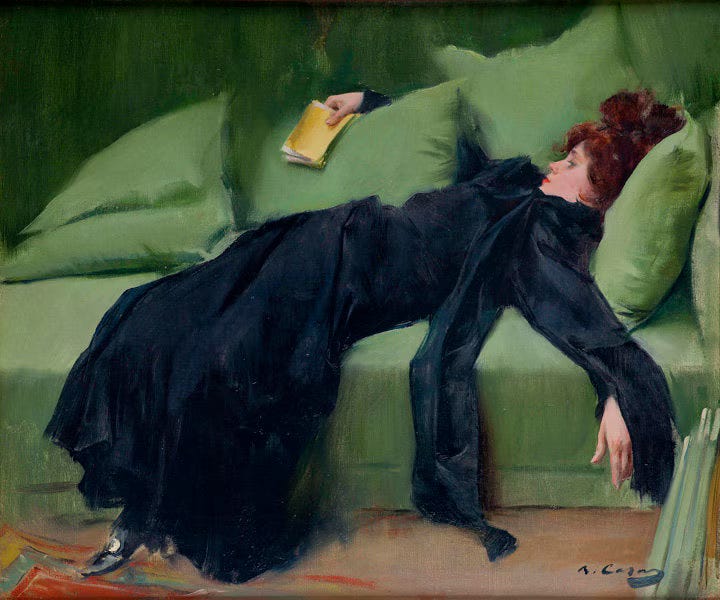
My mum once told me that when she was a child, she'd regularly be so bored that she'd go through the kitchen cupboards and pick out different tins and cans. This wasn't for the purpose of eating, but to read the entirety of their labels, right down to the ingredients list. Nevertheless, she doesn’t remember her childhood to be boring per say, so she reassured me — she was just bored, often.
It isn't an exaggeration to say that I can't even fathom that level of monotony. As someone who was born in the 90s and has pretty much always had the availability of television, toys and a small library of books — which is, of course, a huge privilege — I don't think I've ever felt that kind of desperation for something to do. Now, the opportunities for boredom are even smaller. I have a lot of hobbies, both in and out of my house, I read, I'm always balancing at least three TV series at any given time, I have shelves of cookbooks with recipes I'm always telling myself I should try, and at least 20 potted plants I attempt to keep alive on my patio. That’s not forgetting my phone and the apps on it, which are practically a guarantee that I never need to be bored again if I don't want to be.
But the thing is, I think I would like to be bored. It sounds quite nice – the idea that I could sit with my thoughts for a few minutes, or much longer, and try and figure out what I'd like to do in that moment to keep myself entertained, and then going to do that thing. But I'm beginning to doubt that true ennui is even possible in the age of overconsumption.
Is being bored actually good for you?
Most people would agree that being bored isn't necessarily enjoyable. In fact, one study found that a significant amount of people would prefer to give themselves an electric shock than be left alone in a room with nothing to do for 15 minutes.
Despite this, research has shown that a little boredom can increase creativity. One small study provided half the group with a boring task and half a more interesting one, then asked them to come up with as many uses as possible for two polystyrene cups. Researchers found that the people who did the more boring task were able to generate a higher quantity of – and often more useful – ideas. The study also found that opportunities for daydreaming were key to fuelling creativity. The participants took part in two boring tasks, one that involved writing and one that involved reading, and found that the people who read were more likely to daydream, which led to more creative ideas.

According to another small study conducted by Wijnand A. P. van Tilburg and E. R. Igou, boredom could also make our lives more meaningful and encourage us to do things that benefit other people. Van Tilburg told The Guardian: "Bored people feel that their actions are meaningless and so they are motivated to engage in meaningful behaviour.”
With all this in mind, it appears that a small amount of boredom could be good for us. I think most people would agree that it's an essential, if sometimes annoying, part of existence. However, it's an emotion that a lot of people are experiencing less and less.
Should we seek out boredom?
I'm sure I'm not the only person who would struggle to remember the last time they were properly bored. Not just the 30 seconds of boredom before you remember you have a device that can provide hours of dopamine in your pocket. I'm talking, studying the ingredients of Heinz baked beans, bored.
But making time to be bored feels slightly ridiculous and perhaps defeats the whole purpose – surely you're only truly bored when you have nothing else to do but to be bored? Forcing myself to ignore the urge to pick up my phone doesn't feel like it would create the same state of being, although I'm sure it would be good for me in other ways.
In my quest towards boredom, one thing I'm trying to stop doing is scheduling my entire life. I don't actually add much to my physical or my Google Calendar – mainly birthdays and holidays in the former and deadlines in the latter – but my capacity to schedule my free time mentally verges on neuroticism. If I wake up more than one hour before work, it's to do something I deem productive – exercise, journal, cook. Then, of course, I'm working all day, which is sometimes boring, but only because I have things to do that aren't entirely enjoyable. It’s never the kind of boring that involves having nothing to do. After work, I'm seeing friends or making time for my hobbies or getting through my to-do list.
Recently, I've been making a conscious effort to avoid planning anything during the time I spend alone. Usually, when I realise I have no plans for an upcoming Tuesday night, I'll begin to think about the recipes I could try, the book I want to read or the episodes of The Summer I Turned Pretty I could get to (I'm behind, as I am with everything, so no spoilers please!). These are all lovely, fairly mindless activities, but they're still essentially designed to distract my mind from boredom.
I can't say I've reached the point of boredom in the process yet. I've usually found myself doing one of these activities anyway, or descending into endless doomscrolling. But it's certainly changing the way I'm thinking about what a fulfilling life looks like for me. Often, what that means is telling people I did "nothing" when they ask what my weekend or evening plans were.
This is what I told people I did last weekend, when I was dogsitting alone for my boyfriend's family. It meant spending two whole days alone, something I've been looking forward to for weeks. I spent the weekend in a quiet town just outside of London, but too far for anyone to make plans with me. I can't drive (whatever!) and the only attractions I could reach by foot were a small corner shop and my daily dogwalking route. Yet the weekend sounded more rejuvenating than a tropical beach holiday. As someone who is constantly worried about how many things I have to or could do, the idea of having nothing to do – no errands to run, no plans, no activities – of, well, being bored was something I thought would heal my very overwhelmed brain.
Reader, I hate to break it to you, but an overwhelmed brain is still an overwhelmed brain, even with a complete lack of stimuli. Although my weekend of doing nothing was a much-needed break from my usual busy weekends in London, I still had that instinct to seek out activity. In fact, I did so so successfully that I'd find myself rushing around each morning in order to fit everything I wanted to do into my days. Granted, these were activities I enjoy:reading a new book, playing piano, writing, baking, gardening. But my determination to fit each and every one of these things into my day meant that I was, once again, stressed and overwhelmed by things to do.
 Tiktok failed to load.
Enable 3rd party cookies or use another browser
Desperate for dopamine
My conclusion from my weekend of doing nothing (but actually doing everything) is that it's not a lack of time or an excess of plans or work or hobbies that's making me stressed. It's my relationship with dopamine – the brain's "reward chemical" – which is what motivates us to do things we enjoy. Smartphones are often blamed for our collective "dopamine addiction" and I'm willing to believe that they could be to blame for that, and pretty much everything else at this point.
But I believe that the dopamine problem is also intrinsic to self-optimisation. Figuring out ways you can make your life better – more productive, more interesting, more fulfilling – is bound to release an abundance of dopamine. It can feel addictive, too, but what do we lose in the process? Personally, I've lost the ability to get in touch with my intuition – like, really in touch with it – as well as the ability to just chill out for 30 seconds at any given moment in time.
If I’m totally honest, I don't really know how to regain either of those things, or when I'll next, truly encounter boredom without locking my phone in a drawer and locking myself in a very large, well-stocked kitchen cupboard. Would you judge me if I started carrying around a can of tinned tomatoes in my pocket, instead of my phone, swapping doomscrolling for memorising Mutti's mission statement?*
I'd love to hear about ways you're decreasing your dopamine kicks, and whether you're also craving boredom in the comments. If anyone has any ideas for embracing it that are both suitable for claustrophobics and don't require enormous trouser pockets, I'm all ears.
Otherwise, thanks for reading and I'll be back in a couple of weeks time for more on being less.
*Mum, if you're reading this, I know you didn't have fancy tinned tomatoes in your cupboards when you were eight, but this is my official confession that I regularly spend a small fortune on them.